Skip to the main content.
Developing Effective Leaders

Executive coaching

Inclusive leadership


Supporting Working Parents

Parental transition coaching

Unlocking Talent

Insights and Research

Insights to help leaders and organisations thrive and drive growth & inclusion. 

Geraldine Gallacher Keynote Speaker

Speaker, podcaster, author and master coach. 


Thriving at Work

Work, Family and You

Our resource hub for working parents, carers and managers navigating work-life balance.

Podcast

Shifting the Needle

Real stories from leaders driving inclusion & equity in today’s shifting world.

Newsletters

On Balance

Fortnightly insights on leadership, equity & the future of work. For senior leaders & curious thinkers.

Research RoundUp

A monthly digest of the shifts shaping how we lead and work.

5 min read

The Prototype

The Prototype
Mistaking familiarity for leadership potential: Breaking the Prototype
7:58

Many organisations mistake familiarity for leadership potential, using biased “prototypes” rather than real performance, causing high-performing women and other overlooked talent to be undervalued, even though the evidence shows they often outperform once promoted.

If you have spent years consistently exceeding what was expected of you and delivering results but have not progressed as quickly as your record indicates you should, it's probably not a lack of ability, and it's probably not you. More likely you are being measured by a system not designed to see what you bring.

For thirty years, I worked in financial services. Most of which I spent in senior roles, including at the Board level. I sat in those rooms with other leaders deciding who we wanted to push forward. And for a long time, I wasn't seeing them clearly.

In every organisation, there is an image of what a leader looks like.

It's more than a competency framework, and it's more than a job description. It is better understood as a sense: a feel for that kind of person. Something vague, but an image understood by the people charged with finding the next wave of leaders who are 'ready'.

No one designs this image deliberately, it evolves and as years pass, and the same kind of people are promoted, eventually the pattern stops looking like a pattern and starts looking like the definition of leadership itself.

But if the objective is to find 'the best', then the image is very often wrong. It's actually just a record of all the people who were allowed to try, and this is survivorship bias. The people who made it were studied, and the model of excellence was built from them. The ones who didn't progress are not in the dataset.

Once we have established this prototype, it sees and judges everything else. Certain people are clearly a match, and others, whilst close, need translation and someone willing to take the extra step to explain why they are the best choice. In most systems, as that step doesn't exist, those people don't get considered. The prototype creates the path of least resistance, and organisations flow down that path. After long enough, the two things that are familiarity and excellence become so entangled that the people inside the system can no longer tell them apart.

We know the prototype is ineffective because it's been tested. There is research that demonstrates this so well that it should be mandatory reading for every leader called to evaluate others.

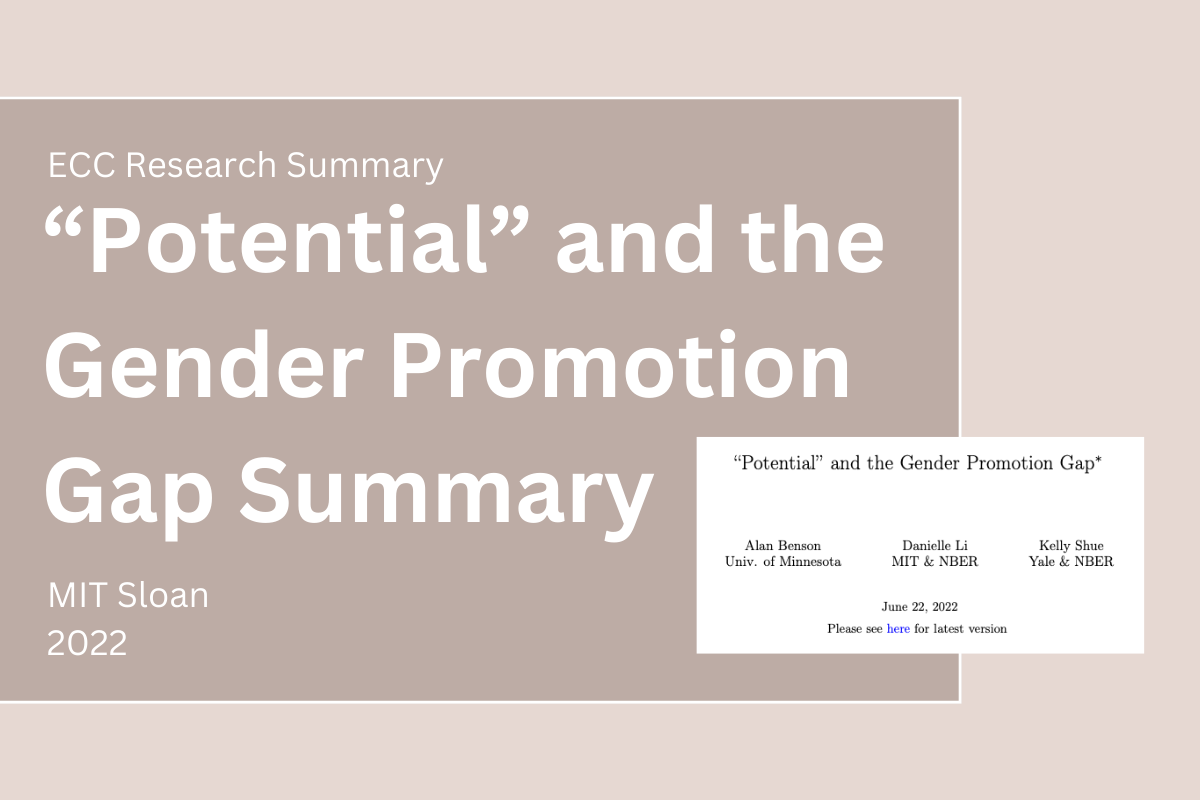
Researchers at MIT, Minnesota, and Yale studied almost 30,000 performance evaluations of managers and found that, on average, women received significantly higher ratings on performance but lower ratings on potential.

The researchers considered whether the women did in fact have poor longer-term prospects and if the evaluations were accurate. But what they found was that the women not only matched their male colleagues' performance when promoted into the same jobs, but they also frequently exceeded it.

The conclusion then was that performance ratings were not measuring potential but a proximity to prototype.

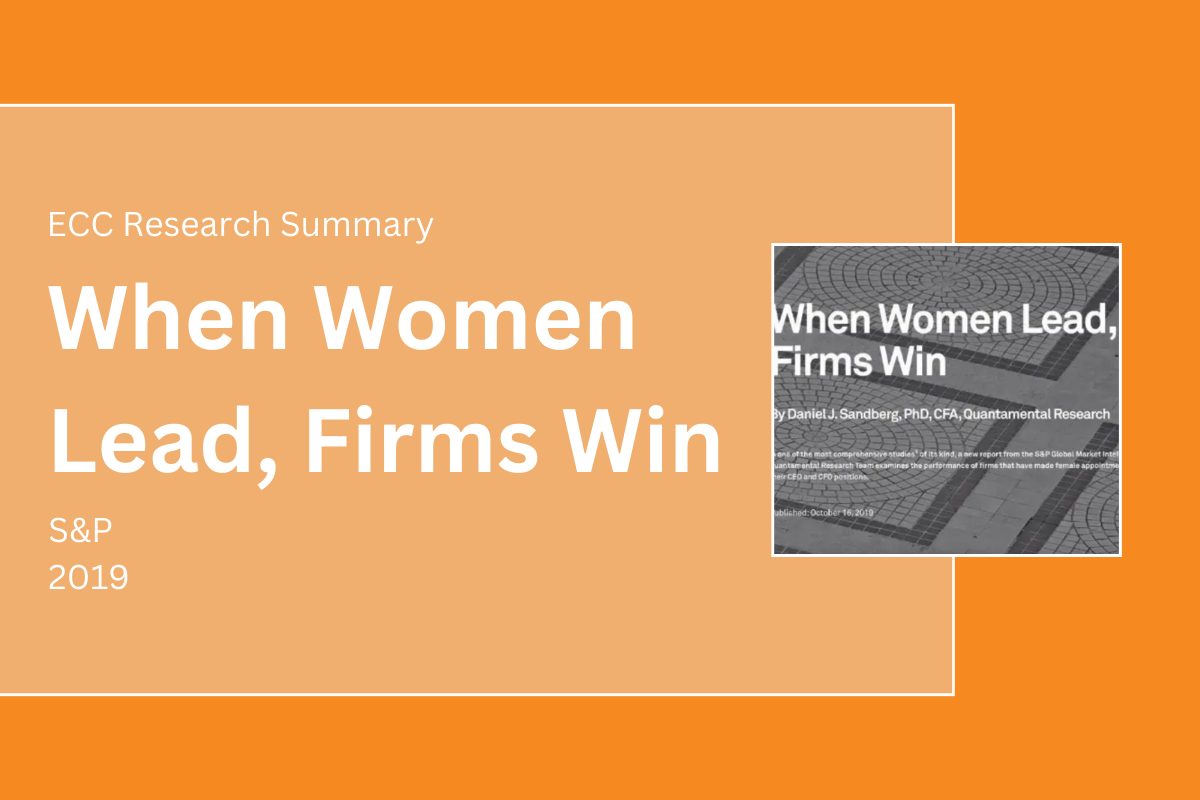
S&P Global quantitative researchers studied every CEO and CFO hire across the Russell 3000 group over 17 years. 5,825 appointments. Firms that hired women CFOs significantly outperformed those that hired men by more than eight per cent in risk-adjusted returns within two years. Whilst female CEO hires created value, male hires did not materially deviate from industry norms. Their research was called 'When Women Lead, Firms Win'. It speaks for itself.

Notably, the researchers asked whether the women were better leaders. Not necessarily - they found that the leadership experience and biographies of the women appointed tended to match the top decile of the male appointments. They concluded that boards in their appointments held women to a much higher standard, and they described the talent pool as 'overfished'; by selecting from the same pool of male candidates for so long, the pool had become shallow.

This system did not, therefore, identify the best person for the job. It was continuing to select for the most easily recognisable person.

For those who have been evaluated like this, with a reputation for excellence at what you do, but told you were not ready for the next step, the chances are, that they weren't judging your potential at all. What it probably boiled down to was this: you were being held up against an outdated metric, developed by observing successful people and then, erroneously, making them the gold standard.

"Presence," "Influence," and "Executive readiness" were not areas of feedback on which you could improve. You believed it because you are a professional and most likely went home and looked in the mirror as if you could fix it. You tweaked, you took up more room, then less, then more again, and tried, and tried, but the bar kept moving.

This might not make you feel better about the years spent trying to fix yourself. However, it might inform you of what you do from here forward. The question now is not what else do you need to work on? The question is, does the institution have the ability to recognise what you have to offer?

Organisations have, with good intentions, tried to address the disparity at the top. But, at best, they have seen inconsistent results. Despite how hard we have tried to solve this wicked problem, the research shows us exactly where we have gone wrong.

Studies show that women managers rated top-performing women employees as having low potential at almost the same rate as men managers.

Emilio Castilla & Benard at MIT found that firms with formal meritocracy policies had larger gender and racial pay gaps than those without.

When employees think that their organisation already values equality, they tend to scrutinise their decisions less. The very idea of meritocracy became the justification for not looking.

The problem is not who is undertaking the evaluation, but what they have been taught to look for in the process. If we keep the template, but change the evaluator, the result will stay the same. This isn't bad people with nefarious intentions. Swap men out for women, put nicer people in the room, have structured interviews, all of it matters, at the margins. None of it touches the prototype because the prototype does not live in any one individual. It resides in all of us.

In hindsight, I suspect I sometimes held women to a different (higher) standard. I don't think I consciously did that. They were excelling. But when I tried to picture these amazing women in more senior roles, I couldn't quite see it There was hesitation, and that was the prototype in action. I wanted those women and those people, men that didn't quite match the mould either, to succeed and thrive. But I stumbled over my own mental frame. I couldn't see them in positions. I didn't see others that looked like them.

That is what the stats look like, close up. Better performance reviews. Lower potential. Not a failure of respect, a failure in imagination.

There were many moments when I could have questioned the pattern, the one in my head and in the system. Although, of course, the system served me well enough that I did not need it to be accurate.

We've known there was a gap for decades. We've developed programmes. We've changed who gets into the rooms. And the prototype is still making decisions.

The prototype is broken, and it's manifestly expensive. And it's the people who have benefitted from the prototype, including me, who have to interrogate it. Where did this come from? How do I know this is the most qualified person and not just the person I know best? It's not going to happen because it's the right thing to do. What organisations care about is money. Billions of pounds of value creation are unclaimed. That's not a diversity factoid, that is value left on the table by people who are so confident in their own capabilities that they don't think to question them. They should. 

“Potential” and the Gender Promotion Gap for women

2 min read

“Potential” and the Gender Promotion Gap for women

A Summary of the Promotion Bias Women Face Despite the strong performance of women in the workplace, their progression into senior roles...

Read More
Leadership Challenges faced by Professionals in Finance and Law

Leadership Challenges faced by Professionals in Finance and Law

Emma Spitz, Executive Coach at The Executive Coaching Consultancy, features on 'What High-Performing Lawyers and Financial Professionals Get Wrong...

Read More
Meritocracy Paradox Explained

Meritocracy Paradox Explained

What is Meritocracy Paradox? Meritocracy explained: The term "Meritocracy" comes from the Greek word "mereo," meaning "to earn," combined with the...

Read More