Skip to the main content.
Developing Effective Leaders

Executive Coaching

Inclusive Leadership


Supporting Working Parents

Parental Transition Coaching

Unlocking Talent

Insights and Research

Insights to help leaders and organisations thrive and drive growth & inclusion. 

Geraldine Gallacher Keynote Speaker

Speaker, podcaster, author and master coach. 


Thriving at Work

Work, Family and You

Our resource hub for working parents, carers and managers navigating work-life balance.

Podcast

Shifting the Needle

Real stories from leaders driving inclusion & equity in today’s shifting world.

Newsletters

On Balance

Fortnightly insights on leadership, equity & the future of work. For senior leaders & curious thinkers.


NEW RESEARCH FOR TALENT AND HR LEADERS · 2026

Are you eroding the investment you've made in your talent returning from parental leave?

Many returners stay but stop progressing. At which point, the value you've spent years building stops growing.

Rachel Hesslegrave | Head of Insights | October 2026

Based on our research with 279 women at 18 international law firms.

READ THE STORY

NEW RESEARCH  ·  15 MIN READ

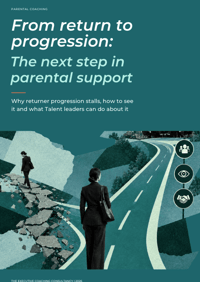
From return to progression - the next step in parental support

THE PROBLEM

The commercial blindspot

A lawyer with ten years' practice is worth far more to the firm than a newly qualified one. Their judgement, client relationships and knowledge of how the organisation works have built up over years, and their contribution grows as they progress.

Healthy retention figures hide stalled progression. The firm keeps the person while losing their fee earning potential. Firms face increased risk of reputational damage as stalled progression impacts women more.

1. You develop them

Years of training, experience and client exposure.

2. You support their leave and return

Cover, wellbeing support and a good return experience.

3. Their progression stalls

They're back and performing well, but no longer on the path they were on, so the return on your investment stops growing.


WHERE THE LOSS IS HIDDEN

Most organisations stop measuring just before progression starts to slip

Return rates, retention and wellbeing are tracked for six months. Progression isn't.

Few firms look at how quickly returners move up, who gets stretch work and sponsorship, or how potential ratings shift over the next two to five years - when returners are most at risk of drifting off their pre-leave path. 

The return on years of talent investment slows, but the problem doesn't show up until further down the line. When it does, no one links it to parental leave. It gets put down to performance, engagement or a thin talent pipeline instead.

The damage often doesn't surface for years. When it does, it's rarely traced back to the return, and it gets logged as separate problems:


A high performer eventually leaves

→ Logged as a retention issue


A gap appears in the succession pipeline

→ Logged as a pipeline problem


Leadership becomes less diverse

→ Logged as a progression issue


WHY IT HAPPENS

Returners keep their capability. The conditions around them change.

Returners don't lose their capability or commitment. Progression momentum slows due to a small number of, often well-meant, decisions.

87%

of the people we coached named their manager as the most important factor in a smooth return.

01

Visibility drops

People who are seen less can be assumed to contribute less, even when their performance hasn't changed.

02

Opportunity narrows

The stretch assignment or high-profile client goes elsewhere, often with good intentions.

03

Ambition gets assumed

Managers decide what returners will want without asking them.

04

Returners respond

They stop putting themselves forward, and the organisation reads that as evidence.

87%

of the people we coached named their manager as the most important factor in a smooth return.


THE PROBLEM IS BECOMING MORE URGENT

Left unaddressed, waste will increase as more men take extended parental leave

Our coaches already see the early signs: fathers who worry their manager is questioning their commitment, and fathers who look for a partner-level role model who has made shared parenting work, and can't find one.

“Either way, it's another early warning sign that his progression, like many women's, may not return to pre-leave levels.”

Paul Neville, Executive Coach, The Executive Coaching Consultancy

Organisations that refocus parental support from retention to progression will be better placed to progress their talent. 

DOWNLOAD THE REPORT

Making-sure-the-investment

OUR RESEARCH SHOWS

Progression doesn't have to stall

We tracked women who received our Parental Transition Coaching through to partnership - a clear and public measure of who keeps progressing.

“The 19% suggests that a returner's progression trajectory isn't fixed.”

Michelle Weston, Executive Coach and Co-CEO

WOMEN REACHING PARTNERSHIP

19%

of women we coached made partner


13%

Law Society benchmark for women


Observational study: an association rather than proof of cause. Source: (2025), Annual Statistics Report 2023: top-line report, Law Society of England & Wales.

HOW TO SEE THE PROBLEM CLEARLY

Five measures show whether your investment is paying back

These ask whether progression is continuing at the pace it was before leave, rather than whether someone came back.

MEASURED USUALLY UNMEASURED Peers Returners the hidden gap 0–6 months Years 2–5 Time since returning from leave →

Illustrative only, not to scale.

01

Promotion velocity

How long do returners take to reach their next promotion, compared with peers at the same level?

02

Stretch work

Are they still getting the stretch work, client exposure and high-profile projects that drive progression?

03

Progression three and five years on

Are they progressing at a comparable rate three and five years after returning?

04

Potential ratings

Do assessments of their potential change after leave? If so, is that based on performance or perception?

05

Senior appointments

What proportion of people who take parental leave reach senior leadership, partnership or succession pipelines?

GET THE FULL REPORT

From return to progression: the next step in parental support

Inside the report:

  • How progression momentum slows, and how to see it in your data
  • Five ways to protect returner progression
  • The role of line managers and coaching
  • Our research on partnership progression

Return to top