The Key Metric That Can Help Close the Gender Pay Gap
Discover how tracking career progression after parental leave can help organisations close the gender pay gap and retain talented women in the...
Insights to help leaders and organisations thrive and drive growth & inclusion.
Geraldine Gallacher Keynote Speaker
Speaker, podcaster, author and master coach.
Our resource hub for working parents, carers and managers navigating work-life balance.
Real stories from leaders driving inclusion & equity in today’s shifting world.
Fortnightly insights on leadership, equity & the future of work. For senior leaders & curious thinkers.
2 min read
Phoebe Rees | Research & Impact Manager

:
May 19, 2026, 10:00:10 AM
Seven years ago, we decided to measure something which is critical for anyone considering a family or a current working parent who is evaluating a job move: how transparent are UK employers around the support they provide for working?

The 2026 report reveals a growing gap between what today's families need to know and what employers are prepared to show.
Download the Parental Fog Index
Working Families Index reports:
9 in 10 working parents say that family leave is a major factor when choosing an employer
92% of parents believe fathers and partners should take leave in the baby’s first year.
74% of working fathers desire equal parenting.
84% of Gen Z fathers want equal parenting but feel workplace stigma inhibits them.
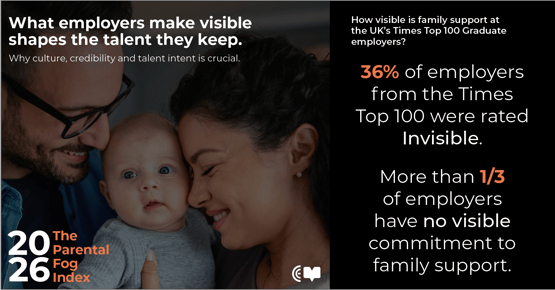
But this year’s Parental Fog Index unveils that transparent support from The Times Top 100 Graduate employers is severely lacking. More than one third have no visible commitment to family support.
Family support is no longer a side issue; it’s a talent signal.
What employers make visible about parental leave, flexible working and family support shapes how prospective employees assess long before they apply. They look for signals and assess whether an organisation appears to understand modern life, and whether people like them can realistically imagine building a long-term future there
Our latest report, produced in partnership with Working Families, finds that just 23% of top graduate employers are rated Beacon or Fully Visible, while 36% show no meaningful visible commitment to family support at all. Only 5% publish uptake data - one of the clearest signs that support is not just offered but genuinely used in practice.
What should employers take into consideration: if support is illusive, vague or absent, employees assume it doesn't exist.
In a labour market driven by rising employer expectations, evolving legislation and a broader understanding of family life, being family-friendly is not just a wellbeing issue or a compliance tick box exercise. It’s a credibility, culture and retention issue.
The good news is that this year’s Index also offers something significant: that best practice is achievable. We’d like to congratulate the nine Beacon employers setting the pace Deloitte, PwC, Civil Service, NatWest Group, NHS, KPMG, Teach First, UBS and Clyde & Co.
Their results show that visible, inclusive family support is not a function of sector or budget, but of prioritisation and consideration.
And congratulations too to the employers rated Fully Visible this year, including Accenture, Amazon, Bank of America, BBC, Deutsche Bank, Environment Agency, Grant Thornton, Herbert Smith Freehills Kramer, HMRC, JPMorgan Chase, Santander, Shell, Tesco and Vodafone.
For many employers, closing the gap does not require new policy. It starts with visibility, specificity and a stronger signal that support is real, inclusive and safe to use.
Discover how tracking career progression after parental leave can help organisations close the gender pay gap and retain talented women in the...
Read this explainer to progress your organisation's understanding of why it's critical support working carers in the workplace.
Explore what the Sandwich Generation is- those who juggle caring for both children and elderly parents, and its impact on their careers.